


So what is Play Therapy?
The Association for Play Therapy defines Play Therapy as “the systematic use of a theoretical model to establish an interpersonal process wherein trained play therapists use the therapeutic powers of play to help clients prevent or resolve psychosocial difficulties and achieve optimal growth and development.”
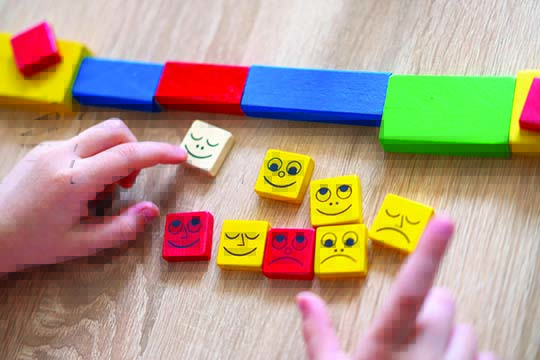
In simple terms, Play Therapy uses a child’s natural language, play, to explore and work through the tough, confusing, and emotional things happening in their life.
Why Play?
The simple answer is that kids don’t talk like adults. If you ask an adult how they felt when they were experiencing a difficult time in life, they would more than likely be able to give you a concrete answer. Ask a seven-year-old how they felt when a parent had to go away to treatment, and you will probably get an answer like “fine” accompanied by shoulder shrugs and sudden interest in staring at the floor. This is where Play Therapy comes in.
Dr. Garry Landreth, a pioneer in the field of Play Therapy, said: toys are a children’s world and play is their language.
iStock credit: Victor Golmer
“Play Therapy uses a child’s natural language, play, to explore and work through the tough, confusing, and emotional things happening in their life.”
If we go back to the seven-year-old and present them with family figures and a dollhouse in the Play Therapy office, suddenly a new story emerges. In their play we see the dynamics of their family play out based on things like who is in the dollhouse and who is not. We see the emotional toll the separation of a parent may have taken on the child, and we see how they are navigating the change in the family. And we see this without the child saying a single word. This all simply happens in the play.
What Actually Happens in The Playroom?
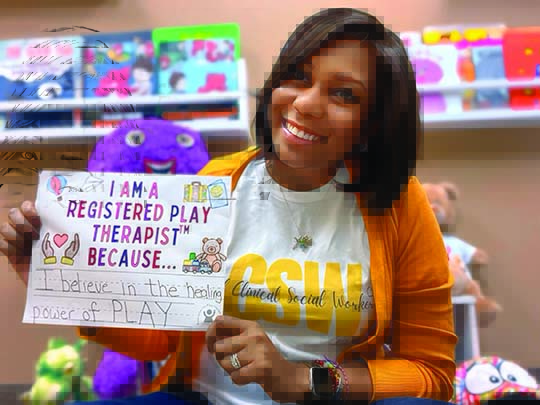
Step into a Play Therapist’s office and you will see shelves filled with toys, games, and books, you can tell that this is where the fun happens. Go a little deeper and you will realize that yes, this is fun, but this is also real work and everything in the space was chosen for a reason. A trained Play Therapist selects toys based on the needs of the child and designed to help the child to navigate the world around them. The purpose of engaging in Play Therapy is to allow a child space to explore real life issues in a safe, supported environment that is geared specifically toward them. Toys are selected to mirror and allow children to practice nurturance, limit setting, creative expression, and emotional release. Even scary and aggressive toys can be part of the process. As Registered Play Therapists™, we are trained to read the themes of the play and to respond in ways that ensure children feel understood, gain new insight, and are able to build new skills in our time together.
As specifically an Adlerian Play Therapist, my work is centered on exploring a child’s behavior through the lens of understanding that all children (and adults) have a deep need to belong, and our behaviors are driven by that: both adaptive (healthy and helpful) and maladaptive (unhealthy and destructive) behaviors. In our play session, we explore the child’s lifestyle and mistaken beliefs, build a relationship, and try new ways of approaching the issue at hand. All of this is done using Legos, puppets, drawing, the sand tray, and much more. Play Therapy creates a space where a child is free to express themselves in their language.
Does it work?
Yes!
Play Therapy has significant research behind it, and so it is considered empirically valid and thus recognized as an evidence-based practice. Several studies have shown how effective Play Therapy with a Registered Play Therapist™ can be for children and families navigating a difficult situation. Play Therapy is used to address a variety of issues children may face: divorce and separation, adjusting to a new school environment, friendship issues, changes in the family dynamics, medical trauma, self-esteem and confidence issues, and much more. Registered Play Therapists™ are licensed mental health professionals who have completed a graduate degree and additional training and supervision specifically focused on understanding and utilizing the therapeutic powers of play.
When and how to reach out
If your child is navigating a major life change, changes in family structure, exhibiting big behavior changes, or struggling with social connections it may be time to connect with a Registered Play Therapist™. To find a Registered Play Therapist™ in your area, you can search the directory at APT.org or other therapist directory sites like Psychology Today, you can ask your pediatrician for a referral, or you can even call your insurance company’s customer service number on the back of your insurance card. And know that just because a clinician has toys in their office doesn’t mean they are necessarily trained in Play Therapy.
So how do you know who to look for?
Look for the credential RPT or RPT-S after their name.
Ask what their theoretical approach is: Play Therapists are trained in different approaches (AutPlay, Adlerian, Child-Centered, Cognitive Behavioral Play Therapy, and more) to ensure the best fit. You need to make sure that their approach is aligned with what you are looking for.
So, do we just play?
Yes, but in that play a child tells us all we need to know. We learn their fears, what they are hoping for, how they see themselves in the world, and the emotional needs they have. When they play, they invite us into their world, and we can listen, even when there are no words.
 Dr. Erica Tatum-Sheade is a licensed Clinical Social Worker and Registered Play Therapist- Supervisor practicing in Phoenix, Arizona. In addition to Private Practice she is an Author, Speaker and Trainer.
For more information on how to connect with Dr. Erica visit https://www.ericatatumsheadelcsw.com