



Every recovery story starts somewhere. Jeremy Bloom’s journey toward building NorthSight Recovery, and eventually Encore OS — did not begin with a software specification or a business plan.
“Technology should make the work feel more connected — not make people feel farther apart.”
That experience shaped Bloom’s belief that behavioral healthcare must be built around meaningful human connection. When a person reaches out for help, every part of the organization should be prepared to support the same journey — from the first call and insurance verification through admission, clinical care, continuing support, and long-term recovery.
Bloom carried that belief into NorthSight Recovery, which he founded in Tempe in 2022. But as the organization grew, he discovered the systems supporting care often worked against that connected vision. Human resources, payroll, admissions, clinical documentation, compliance, and financial reporting all lived in different places. Employees repeated work, leaders reconciled reports by hand, and information could lose context as it moved from one department to another.
For Bloom, the problem was not simply inefficiency. Every unnecessary administrative step represented time, attention, and resources that could have been invested in employees, programs, and the people seeking care.
With experience in both software development and behavioral-health operations, Bloom could see that the industry did not merely need another stand-alone tool. It needed a more connected foundation. That realization led to a question that became increasingly difficult to ignore.
The question that would not let go
Why is it so difficult to see the full picture?
The question was not an idle complaint. NorthSight was operating in an environment familiar to behavioral-health leaders across Arizona: narrow margins, limited resources, demanding compliance requirements, workforce shortages, and an urgent responsibility to respond when someone asks for help.
At the same time, staff were navigating a care journey that crossed multiple departments and systems: the initial call or referral, insurance discovery, eligibility and benefits, admission, clinical documentation, workforce scheduling and credentialing, billing, finance, compliance, and outcomes. Each transition created another opportunity for information to be reentered, delayed, or separated from the people who needed it.
Bloom had previously observed that healthcare lagged other industries in its use of technology and that cloud-based systems could help organizations minimize waste and maximize capability when resources were tight. Running NorthSight made the consequences of that gap tangible. The money and time spent untangling systems could not be spent strengthening programs, supporting employees, or expanding access to care.
NorthSight’s early outcomes also reinforced what was possible when barriers were removed. In an early review, the organization reported that 92% of clients faced social-determinants-of-health challenges at admission. Among clients unemployed at admission, 68% obtained employment within 90 days; clients without diplomas worked toward GEDs; and overall satisfaction reached 94%. The care model was creating meaningful progress. The operational infrastructure underneath it still demanded too much from the people delivering that care.
What if every department worked from the same truth?
That question became the foundation of Encore OS.
Encore was not conceived as another software product for its own sake. It grew from a belief that the mission behind NorthSight— human connection sustained throughout recovery deserved technology that supported the work instead of adding to it.
Encore OS is being built as a connected, modular operating platform that brings together the information and workflows an organization depends on. Rather than asking human resources, payroll, finance, clinical operations, admissions, compliance, and leadership to work from separate versions of the truth, the vision is for each function to operate from a shared foundation.
For behavioral health, that connection can help preserve continuity across the entire client journey. The person calling for help should not have to start over at every transition. The admissions team should be able to see what it needs without recreating work already completed. Clinical teams should receive relevant information with context. Leaders should be able to understand staffing, service delivery, financial performance, and outcomes without assembling the organization by spreadsheet.
The goal is not efficiency for efficiency’s sake. It is what efficiency gives back: more time for people, greater clarity for leaders, fewer administrative obstacles for employees, and more organizational capacity to serve the community.
Born in behavioral health. Designed to flex beyond it.
Encore OS was born in behavioral health, where disconnected systems do more than create inconvenience. They consume scarce resources, increase administrative burden, slow decisions, and pull attention away from people seeking care.
NorthSight became the real-world environment where Encore’s capabilities were shaped, tested, and refined around the operational realities of behavioral healthcare. The industry presents an unusually demanding combination of shifting census, licensed and credentialed workforces, complex payer requirements, privacy obligations, clinical documentation, quality oversight, and financial pressure. Building around that complexity required the platform to be flexible from the beginning.
That flexibility is what allows the vision to extend beyond behavioral health. Nonprofits, healthcare providers, and growing service businesses often face the same underlying challenge: important information is divided among systems that were purchased separately and never designed to work as one organization.
Encore’s modular approach is intended to let an organization connect the capabilities it needs and add others as it grows. The organization should not have to abandon the way it serves people simply to accommodate rigid technology. The technology should adapt to the organization’s workflows, responsibilities, and mission.
Behavioral health is therefore more than Encore’s first market. It is the source of the problem the company is committed to solving and the environment that taught its founders what connected operations must accomplish. At the same time, the lesson carries farther: wherever administrative complexity is competing with the human work of an organization, there is an opportunity to give time and clarity back.
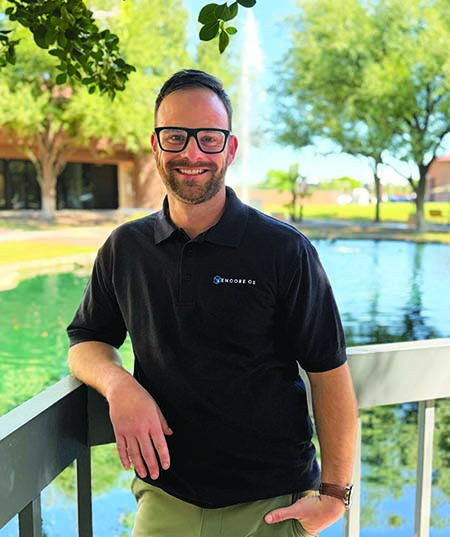
Jeremy Bloom, founder and CEO of NorthSight Recovery and founder of Encore OS, built his companies on a simple promise: one platform to power every workflow for any business.
Built by people who understand both sides of the screen
Encore’s perspective comes from having lived inside the operational problem. Its capabilities were not mapped solely from a list of software features. They were informed by the daily responsibilities of operating a behavioral-health organization: supporting employees, maintaining credentials, protecting sensitive information, meeting compliance expectations, managing payroll and finances, understanding program performance, and remaining accountable for the quality of care.
That experience also shaped a human-centered approach to artificial intelligence and automation. The purpose is not to remove people from recovery or replace professional judgment. It is to reduce repetitive administrative work, surface useful information, and help employees focus their attention where human connection matters most.
Technology should make the work feel more connected—not make people feel farther apart.
The next chapter
NorthSight Recovery remains the organization Bloom built to answer his first question: how can people be supported through a more connected recovery experience? Encore OS represents the next question: how can the organizations serving people be supported by a more connected operational experience?
For Arizona’s recovery community, the connection between the two ventures matters. Encore did not begin with technology searching for a market. It began with a behavioral-health organization searching for a better way to serve its employees, understand its operations, protect its resources, and keep its attention on people.
Now, the vision is expanding: first to other behavioral-health providers that recognize the same fragmentation, and then to nonprofits, healthcare organizations, and businesses whose missions have also outgrown the disconnected systems beneath them.
The promise is straightforward: one platform, every workflow, any business. But the purpose behind that promise remains deeply human—to give organizations their time back so they can invest it where it matters most.
Ready to see Encore OS in action? Request a demo by sending a message to support@encoreos.io Website encoreos.io