


 In Part One, we explored how intergenerational pain travels—not as a story, but as a state—moving through attachment wounds, cognitive distortions, nervous system dysregulation, and the quiet, unconscious ways we recreate what we never fully processed. In this second part, we see the importance of grief in lightening some of the pain that drives process addictions so that we can build resilience and experience post traumatic growth.
The Central Role of Grief (Lyrical Version)
No conversation about intergenerational healing is complete without grief. Grief is not a side road or a setback on the path of recovery—it is the path. What we do not weep, what we are never given permission to mourn, does not disappear. It settles into the body as tension, as anxiety, as depression, as compulsive striving or quiet despair. Grief is the way frozen pain begins to thaw, the way what has been held too long finally finds movement—through tears, through anger, through the honest language of the body.
When grief is allowed, something softens. What has grown rigid in us loosens. Defenses that were once essential begin to relax, not because they were wrong, but because they are no longer needed. We learn—often to our surprise—that feeling our pain can be safe, that it does not have to exile us from connection. In the presence of others, our sorrow becomes recognizable, even shared. The nervous system is given a chance to complete experiences of feeling and meaning-making that were interrupted long ago.
And grief, when it is held and witnessed, does not diminish us. It does not break us open in vain. It gathers us back into ourselves. It integrates what was split off for survival and returns it to the whole. In this way, grief does not weaken us—it quietly restores our capacity to be fully, honestly human.
Process Addictions
There is another way unhealed pain travels through generations, and it is quieter, more socially acceptable, and often harder to recognize. We tend to think of addiction only in terms of substances, but many of the most persistent expressions of unresolved trauma are process addictions—compulsive behaviors that regulate the nervous system without ever truly resolving what hurts. They grow out of the emotional dysregulation that is so central to trauma, black and white thinking, feeling and behavior.
These are the sneaky ones. Overeating, Undereating. Overworking. Underworking. Overexercising, Collapse into inactivity. Overgiving. Perfectionism. Compulsive caretaking. Emotional intensity in relationships. Doom-scrolling. Shopping. Gambling. Food. Sex. Even chronic busyness. On the surface, many of these behaviors look functional, even admirable. You seem thin and wear clothes well, have lovely things or you’re a great earner. You’re super fit. But underneath, they sometimes can have a compulsivity to them: they soothe, distract, numb, or stimulate a nervous system that doesn’t know how to rest.
Process addictions are not necessarily about weakness or lack of willpower. They are about regulation. When early environments didn’t teach us how to tolerate discomfort, uncertainty, or emotion, we find ways—often very creative ways—to manage those states externally.
The behavior becomes a shortcut to relief. And because the relief is temporary, the behavior repeats. Over time, the nervous system comes to depend on the process itself, not because it brings joy, but because it brings momentary quiet.
This is where choice begins to feel harder. Not because we don’t want to choose differently, but because the nervous system is already activated before we’re aware of it. By the time the urge shows up, the body is seeking relief, not reflection. Choice requires space. Process addictions collapse that space. They offer speed instead of presence, discharge instead of digestion, action instead of meaning.
Healing doesn’t begin by ripping these processes away. That would only create more threat. Healing begins by understanding what the behavior has been doing for us. What feeling does it manage? What moment does it help us avoid? When we approach process addictions with curiosity instead of judgment, we begin to restore choice—not by force, but by expanding the nervous system’s capacity to stay present without needing to escape.
That’s when the North Star comes back into view. The work becomes less about stopping a behavior and more about learning how to stay with ourselves—our bodies, our emotions, our relationships—long enough to make meaning instead of acting it out. And that, quietly and steadily, is how choice begins to widen again.
Resilience and Post Traumatic Growth
Resilience is often misunderstood. We tend to think of it as toughness, grit, or the ability to push through. But true resilience is not about muscling our way past pain. It is about adaptation with awareness. It is the nervous system’s capacity to bend without breaking and, over time, to return to itself after stress.
Many people who grow up in difficult environments are already resilient in one sense. They survived. They adapted. They functioned. But survival resilience is not the same as restorative resilience. Survival resilience keeps us going; restorative resilience allows us to soften. And for many people, softening feels far more dangerous than strength ever did.
Post-traumatic growth does not arise from trauma itself. Trauma alone does not make us wiser, kinder, or deeper. Growth emerges from what happens after—from meaning-making, from repair, from grief that is allowed to move, and from relationships that offer safety rather than repetition. Without these conditions, trauma simply loops. With them, something new becomes possible.
One of the first signs of post-traumatic growth is not positivity—it is choice. The pause before reaction. The ability to feel without immediately discharging or numbing. The growing sense that you can stay with yourself through discomfort without abandoning yourself or controlling others. These are nervous system achievements, not personality traits.
Over time, resilience shifts from endurance to presence. People begin to recognize their internal states earlier. They recover more quickly from rupture. They no longer need to reenact pain in order to feel alive or connected and when they regress, they feel sick inside. Boundaries become clearer. Self-compassion becomes possible—not as a concept, but as a lived experience in the body. And violating boundaries feels yucky.
Post-traumatic growth often shows up quietly. It may look like choosing a different partner than you once would have or being different with the same person. Apologizing without collapsing into shame. Resting without guilt. Allowing joy without waiting for the other shoe to drop. These are not small changes. They are signs that the nervous system has learned something new about safety and trust.
And here is the intergenerational piece that matters so deeply: when resilience is embodied rather than forced, it becomes transmissible. Children learn not just how to survive stress, but how to recover from it. They learn that emotions can move and settle. That conflict can be repaired. That life can be challenging and meaningful at the same time.
This is how the legacy shifts. Not because the past was erased, but because it was metabolized. Not because pain didn’t exist, but because it was held, grieved, and integrated. Resilience, in this sense, is not heroic. It is human. And post-traumatic growth is not about becoming extraordinary, it is about becoming more fully ourselves.
The Messy Beauty of Choosing Differently
Breaking intergenerational cycles does not mean you will never make mistakes. It means you begin to notice them sooner. You feel them stir in your body before they harden into action. You repair more honestly. You apologize with less defensiveness and more truth. You reflect more deeply, not to punish yourself, but to understand. It means choosing awareness over automaticity, connection over control and responsibility over blame.
This is messy work. But so is passing on pain.
The difference is that one kind of mess leads to freedom.
When you orient toward recovery—like a North Star—you may never arrive at some mythical state of completion. But you will know, in your body and in your relationships, that you are heading somewhere kinder. You will feel it in the way your shoulders soften, in the way your breath deepens, in the way conflict no longer feels like something you have to shut down, run from or scream at.
And that direction matters.
Not just for you—but for everyone who comes after.
This is what I write about in Growing Up with Addiction. I look at recovery through the lens of both mind and body, trying to pass on what I have learned by living inside several generations,by being a daughter, a mother, a grandmother and by spending more than forty years as a psychologist working in the fields of addiction and recovery. What time teaches you, if you let it, is that healing is rarely dramatic. It is quiet. Incremental. Earned.
One of the clearest signs that recovery is real is not how eloquently we can talk about our past, but how differently we respond in the present. Recovery shows up in the pause before reaction, in that small, almost sacred moment when we feel our body activate and choose not to hand the wheel over to an old pattern. We begin to recognize what belongs to now and what belongs to then. Our responses carry less urgency, less distortion, less emotional weight from history.
We listen more fully.
We repair more quickly.
We set boundaries without collapsing into guilt or armoring into aggression.
Dr. Tian Dayton is a clinical psychologist, certified trainer in psychodrama, sociometry, and group psychotherapy, and Senior Fellow at The Meadows. She is the creator of Relational Trauma Repair (RTR) and author of fifteen books, including Growing Up with Addiction and Treating Adult Children of Relational Trauma, and a former professor of psychodrama at NYU. A recipient of multiple national awards, she has appeared as a guest expert on major media outlets.
Learn more at tiandayton.com and relationaltraumarepair.com
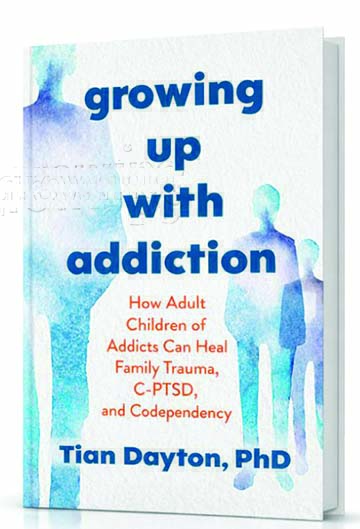 Tian Dayton’s latest book, Growing Up with Addiction was released on March 3, 2026. Visit
https://www.amazon.com/Growing-Up-Addiction-Children-Codependency/dp/1649634242
Be Sure To Follow
Tian Dayton
https://tiandaytonphd.substack.com/